Authors:Tianjin Liu;Xinke Wu (Zhejiang University)
Abstact:
In recent years, high-frequency high-efficiency DC/DC converters become popular in various applications. While conventional DC transformer (DCX) can achieve very high efficiency at high switching frequency, they are unable to realize voltage regulation due to the fixed switching frequency and duty cycle. To overcome this limitation while maintaining the benefits of DCX, a few partial-power-processing converters based on DCX have been invented for some applications. However, due to the absence of construction method for these regulated DCX (RDCX) converters, their topology types are limited and unable to fulfill the requirements of various applications. In this paper, a general method to construct RDCX by utilizing two-port auxiliary network is proposed. According to this method, some new RDCX topologies are derived and a family of high-frequency high-efficiency RDCXs is constructed to meet the requirements of more applications. To make full use of these RDCX topologies, their implementation consideration is discussed in detail and the characteristics of their suitable applications are summarized.
Prototype:
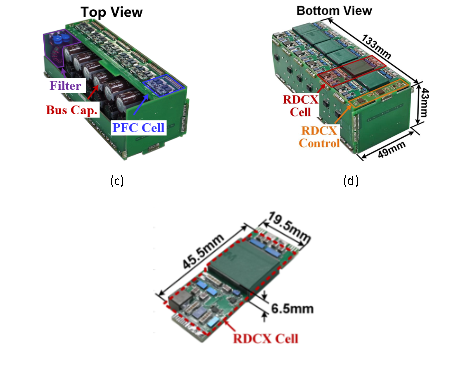 Prototype of 6-cell AC-DC converter
- Power density of the RDCX cell: 1400W/in3
- Peak efficiency of the RDCX cell: 98.3% (@ 60% load), and the efficiency at full load: 98.0%