September 9, 2026
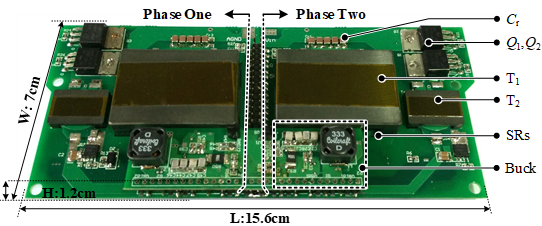
Authors:Hui Chen;Xinke Wu;Shuai Shao (Zhejiang University) Abstact: In this paper, a current-sharing method for an interleaved high-frequency LLC converter with partial energy processing is presented. A small transformer and an auxiliary low-power dc-dc converter are added in each phase, and the current sharing between phases is achieved by controlling the duty cycle of the auxiliary converter. Only partial energy is processed by the auxiliary converter; hence, the power losses of the added auxiliary converters are minimized, and the overall high efficiency is maintained. By transforming the current sharing of the resonant converter into pulse width modulation control of a dc-dc converter, the proposed method is simple to implement and easy to extend to multiple phases. The frequency of the auxiliary converter is independent of the main LLC, so the LLC can operate at a fixed switching frequency and duty cycle, and it is suitable for high-frequency applications. The operating principle, […]
August 21, 2026
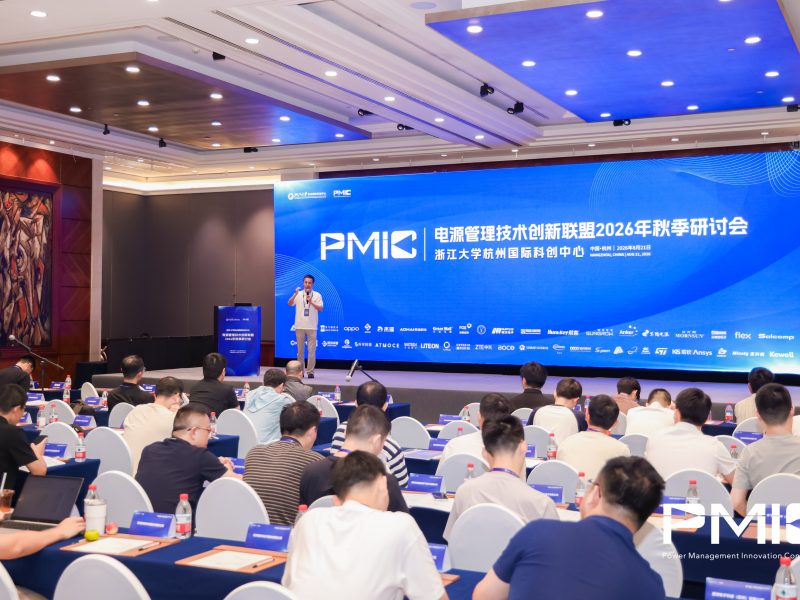
On August 21, 2026, the Power Management Innovation Consortium (PMIC) of the Hangzhou International Science and Technology Innovation Center, Zhejiang University, held its 2026 Autumn Technical Symposium in Hangzhou. Centering on the core theme of “AI Compute Power Supply Challenges,” the symposium focused on future development trends in the field of power management, prioritized breakthroughs in common technical challenges facing the industry, and reported the latest progress of multiple ongoing consortium research projects, including high-power-density DCX converters. The symposium was co-chaired by Professor Zhang Junming, Associate Professor Shao Shuai, and Associate Research Fellow Yan Haidong of Zhejiang University. Experts, technical representatives, and graduate students from more than 40 member companies, universities, and research institutes attended the symposium. Third-Generation Semiconductor Devices: Unlimited Potential At this symposium, Professor Zhang Yuhao of the University of Hong Kong and Associate Professor Ren Na of Zhejiang University were specially invited to give presentations. Professor Zhang […]

June 24, 2026
Recently, the list of winners of the Zhejiang Provincial Intellectual Property Award was announced. The invention patent “A Voltage Balancing Device for a Power Conversion Module and a Power Conversion System” from the patent pool of the Power Management Innovation Consortium of the Hangzhou International Science and Technology Innovation Center, Zhejiang University (hereinafter referred to as the Science and Technology Innovation Center), won the second prize of the Patent Award. This is an authoritative honor in the field of intellectual property in Zhejiang Province, and also an affirmation of the consortium’s continuous deep cultivation and achievement transformation in the field of high-efficiency and high-power-density power management technology. Global annual electricity consumption is about 30 trillion kWh, of which about 60% must be converted by power electronic devices. If the overall efficiency of such devices is improved by 1 percentage point, the annual electricity savings can reach 180 billion kWh, approximately […]
June 24, 2026
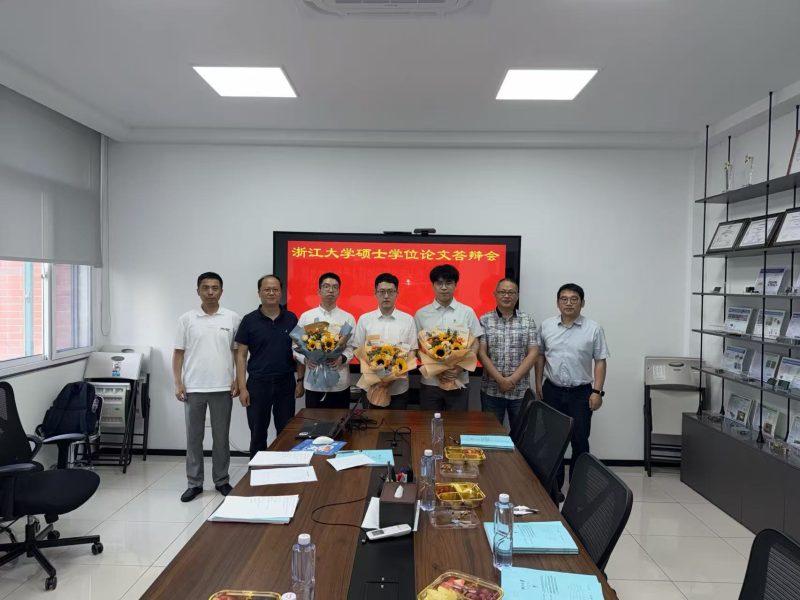
Recently, three master’s students from the ZJU-PMIC team successfully passed their thesis defenses. The two students who defended this time achieved innovative results in areas including high-temperature dynamic resistance evaluation of GaN devices and series-connected silicon carbide power modules. Thesis Title: Evaluation and Analysis of High-Temperature Dynamic Resistance of GaN Devices Based on Multiple Double-Pulse Tests Defendant: Jiang Xu (Master’s Student) Supervisor: Wu Xinke Research Summary: Gallium nitride high electron mobility transistors (GaN HEMTs) have broad application prospects in high-frequency, high-efficiency power electronics, but their dynamic on-resistance degradation seriously affects high-temperature reliability and efficiency. Existing evaluation methods are mostly limited to room temperature and simple operating conditions, making it difficult to reflect actual complex operating states. This paper builds a high-temperature dynamic resistance test platform with controllable junction temperature, adopts a multiple double-pulse test method, and further simulates complex operating modes such as intermittent operation of the device by adjusting […]
June 9, 2026
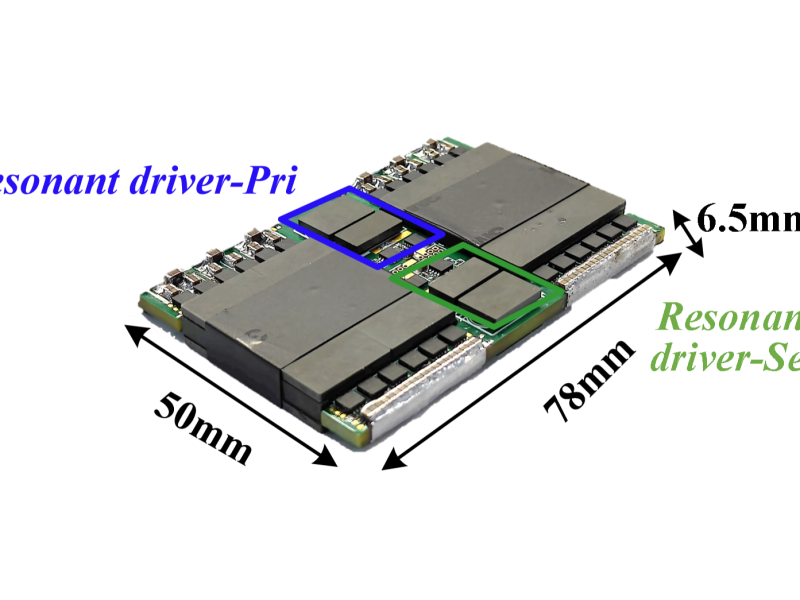
For applications such as tethered drones that require a wide voltage range and high-efficiency, high-density converters, the ZJU-PMIC team previously proposed an input-series output-parallel (ISOP)cellular DCX scheme, as shown in Figure 1. It reduces device losses caused by high electrical stress and adopts a half-bridge topology with X7R surface-mount capacitors as resonant capacitors to improve power density. Fig.1 Cellular DCX topology As the output voltage decreases, due to the nonlinearity of the output junction capacitance of the switches, the charge required to achieve ZVS does not decrease significantly, while the magnetizing current decreases linearly, causing the switches to fail to achieve ZVS and increasing switching losses. For the half-bridge X7R resonant capacitor, its capacitance is also nonlinear and increases as the output voltage decreases, causing the resonant period to mismatch the switching period, which increases the RMS resonant current and increases conduction losses. In short, when the output voltage is […]
June 8, 2026
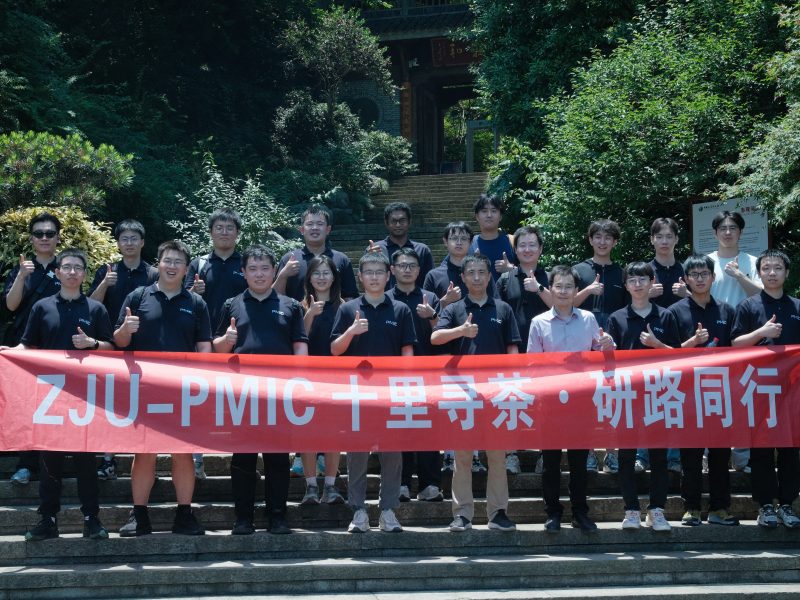
In the early summer, the breeze is fresh and the tea-covered hills are lush green. On June 1, 2026, the ZJU-PMIC team headed to the Longjing secret realm to launch a team-building event themed “Ten Miles of Tea-Seeking · Walking Together on the Research Path,” hiking along the Langdang Ancient Trail, taking in the Longjing tea fields, gathering strength amidst the mountain scenery, and walking side by side through fun competitions. Hiking and Exploring, Traversing Ten Thousand Mu of Longjing Tea Plantations This team-building event started from the Shililangdang Archway in Meijiawu, climbed up along the mountain stone steps, passed the Sanfencha landmark of the Shifeng Mountain range, and traveled deep through the core ecological tea plantations of Longjing. With emerald-green tea hills rolling on endlessly before the eyes and the breeze carrying tea fragrance across the mountains, the ZJU-PMIC team climbed together, chatting about daily research as they walked, […]
April 24, 2026
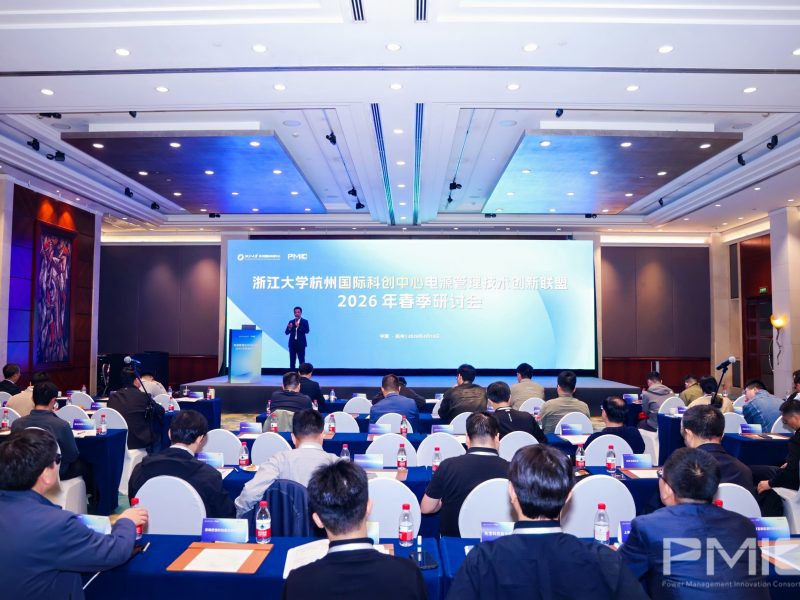
The Power Management Innovation Consortium 2026 Spring Symposium Was Successfully Held in Hangzhou On April 17–18, the Power Management Innovation Consortium 2026 Spring Symposium was successfully held in Hangzhou. Nearly 150 experts, scholars, technical representatives, and graduate students from more than 40 member companies, universities, and research institutes gathered for the event, engaging in in-depth discussions on frontier fields such as data center power supply architectures and wide-bandgap device characterization. At the joint meeting of the Management and Technical Committees held on the 17th, PMIC systematically reviewed its work achievements in 2025 and released its 2026 work plan. Reviewing 2025: Over the past year, PMIC continued to deepen industry-university-research collaborative innovation, further optimized its member service system, and made phased progress in multiple key research directions. At the same time, PMIC also achieved steady accumulation in talent cultivation and industry influence. Looking Ahead to 2026: Facing the industry challenges brought […]
April 14, 2026
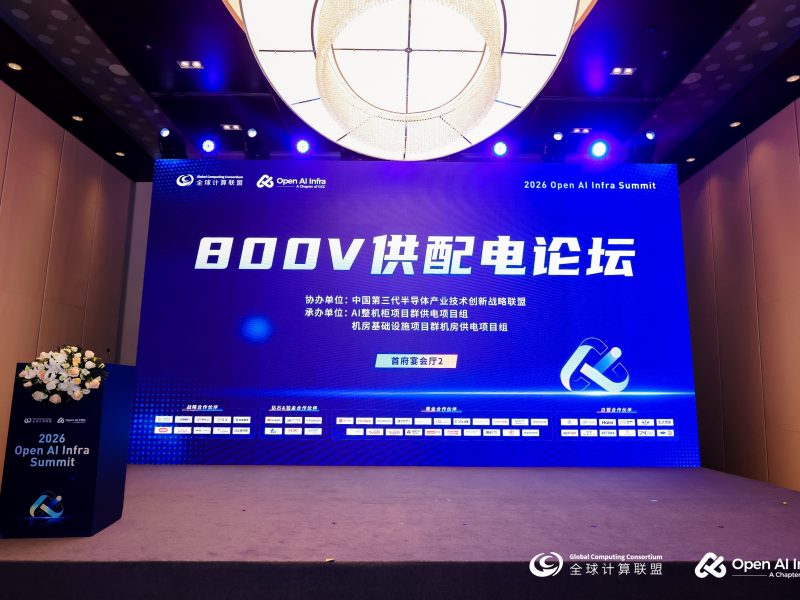
With the explosive growth of AI large models and computing centers, the power of a single rack is rapidly moving from tens of kW toward hundreds of kW and even higher levels. As the power of a single rack in intelligent computing centers advances from tens of kilowatts to hundreds of kilowatts, the underlying logic of power supply architectures is being reshaped by the torrent of computing power demand. At the recently held Open AI Infra Summit 2026, Professor Wu Xinke, Professor at the College of Electrical Engineering, Zhejiang University, and Executive Director of the Power Management Innovation Consortium (PMIC), was officially appointed as a member of the Open AI Infra Community Advisory Committee and chaired the “800V Power Supply and Distribution Forum.” As one of the core agenda items of the summit, “Thematic Forum 2: 800V Power Supply and Distribution Forum,” chaired by Professor Wu Xinke, became the focus […]
March 28, 2026
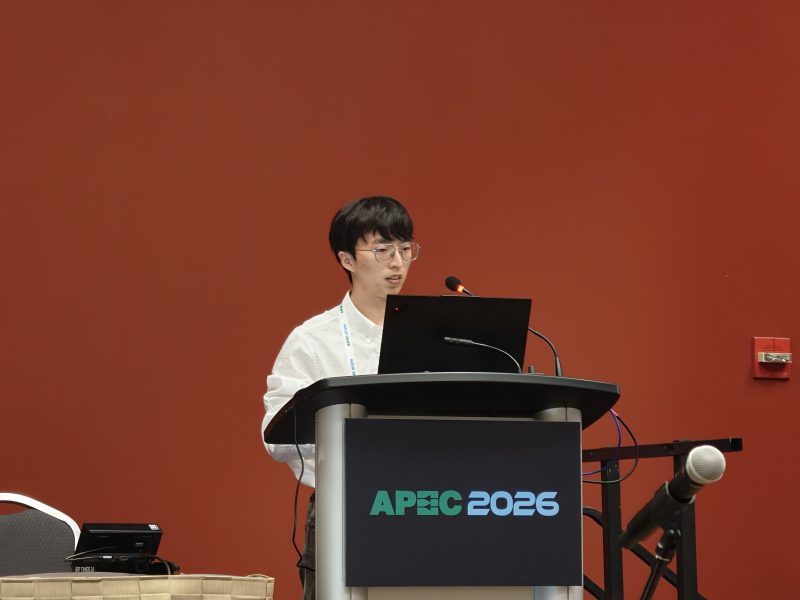
From March 22 to 26, 2026, the 41st IEEE Applied Power Electronics Conference and Exposition (APEC 2026) was held in San Antonio, Texas, USA. Fu Chaowei, a doctoral student of the Power Management Innovation Consortium (PMIC), attended the conference and delivered an oral presentation titled “10MHz 48V-12V DCX With 6100W/in³ Power Density for Future Data Center Applications.” IEEE APEC is a globally recognized top-tier academic conference in the field of power electronics, covering frontier directions such as power devices, converter topologies, control technologies, and system integration. It attracts thousands of experts, scholars, and company representatives from academia and industry every year. At this conference, focusing on the high-density power supply needs of future data centers, Fu Chaowei presented the innovative research achievement “10MHz non-isolated 48V-12V DCX.” The year-by-year increase in GPU power consumption imposes stringent requirements on the power density of board-level 48V-12V power modules. Centering on the theme of […]

March 20, 2026
Recently, two graduate students from the ZJU-PMIC team successfully passed their thesis defenses. The two graduate students in this defense achieved innovative results in the fields of magnetic integration technology and self-powering for medium-voltage DC transformers, respectively. Thesis Title: Research on High-Frequency Miniaturization Mechanisms of Magnetic Components and Interleaved Topologies with Multiphase Coupled Inductors Defendant: Wang Binhao (Master’s Student) Supervisor: Zhang Junming Research Summary: As power electronic systems evolve toward extreme high power density, the volume and weight of magnetic components have become a major bottleneck constraining system miniaturization. Although increasing the switching frequency is a direct path to reducing the volume of magnetic components, limited by magnetic material losses and thermal design constraints, the volume reduction benefit brought by simply increasing frequency has tended to saturate. Therefore, magnetic integration technology has become a key technology for breaking through traditional design limitations and improving power density. Using a data center […]